Townshend’s Recording Rigs and Tips
All Fender Except the Joe Walsh Rig
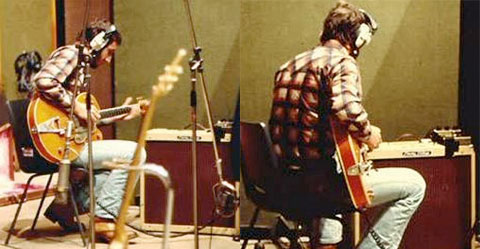
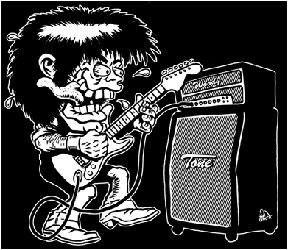
This looks like the Joe Walsh rig....
I recently subscribed to Guitar Player’s GP2 on-line mag (subscribe here – it’s free) because this time I saw Pete Townshend on the cover. Had to read it, and glad I did. Following are some cool tone-making and tone-recording excerpts from the interview.
Studio Rigs
All quotes are from Pete:
“In the studio I just plug an old Telecaster into an old Fender Deluxe, shove a Shure 56A in front of it, straight into a Neve 1066 with a compressor, down to tape. I get a guitar sound in 5 seconds that blows my socks off. They had this stuff back in 1956….
“On The Who records I often used my Hiwatt amplifiers – rarely a stack, just a head and a 4×12. Whatever guitar I happened to be using sounded good with this rig…. The mics would usually be a Shure 56A close up, but [producer] Glyn Johns often used a Neumann U87 or KM86 about a foot away.
“I also used, and still use, a rig made for me by Joe Walsh. This is an orange Gretsch Chet Atkins, deeper body, through an Edwards light-diode 110-volt volume pedal, designed for pedal-steel, into a 1965 Fender Bandmaster. This fives that grungy Neil Young sound I use sometimes. You control the distortion with the pedal rather than the amp.”
[Amazing. Walsh is a tone-fiend!]
> Pete mentioned he also records direct with, Danelectros (“those ‘lipstick’ pickups are genius”) and also uses his Fender Vibro King amps to record but likes a compressor with them.
> He says his favorite guitar is “the ’56 Telecaster. Orgasmic. Sell your house or your Picasso, and buy one. Or steal mine.”
Recording Advice
“…what advice I would give to those who want to make records at home: If they want those records to sound like well-regarded records made at a certain time, they may need to emulate the equipment used rather more exactly than software designers are prepared to admit is achievable. An emulation of an RCA ribbon mic is not going to sound like an RCA ribbon mic.
“Phil Spector’s famous mono recordings were often made…at Gold Star Studios in Los Angeles. They had a very cool mono reverb room there that sounded better than any other in the world. They weren’t sure how it happened. There was some trash on the floor in the corner they didn’t dare move.
“They did this to the mono version of ‘I Can See for Miles.’ There is no better version of the song.
“So remember, start with a good-sounding space. And if it sounds bad, fix that first. Next, buy at least one truly great microphone. Next, buy at least one truly great mic preamp. If you can, buy a single module from some old board – an API, a Neve or whatever.
“If you start with digital hard disk [vs. tape], try some test sessions at different sample rates and bit depths – you may be surprised that your system sounds better at ‘lower’ quality rates rather than higher because it doesn’t have to work so hard.
“If you can afford none of these things, buy a small tape Portastudio. Four tracks will sound better than eight.”
On recording drums, and noting that back in the day it would sometimes take a week to get a good drum sound:
“Often it was the room that the drummer was in that mattered the most. Surely even a home studio enthusiast could haul his gear to the local gym one day? Or a church hall? Or a school? The bathroom can be good too…take out all the soap and towels.”
Category: Fender, Gretsch, Hiwatt, Joe Walsh, Pete Townshend, Telecaster
Subscribe
If you enjoyed this article, subscribe to receive more just like it.


Comments (5)
Trackback URL | Comments RSS Feed
Sites That Link to this Post
- WoodyTone! - Believe It Or Not: Joe Walsh Loves Roland Cubes | February 26, 2010




There must be a typo. Townshend's Bandmaster is a Late 50's Tweed 5E7. I know…I played through it once, many years back. It got me hooked on 5E7s for good!
I believe the amp in the picture is actually a vintage Peavey, which he also used on the Rough Mix session. Look closely and you'll see a Big Muff on top.
I believe the amp in the picture is actually a vintage Peavey. And the Tele you mentioned is a '52 Tele, not a '56.
The Amp is a ’70s era Peavey Vintage 4X10 with an Electro Harmonix Big Muff from the same era on top.
The Telecaster in question ti this thread IS in fact a ’56 and NOT a ’52.
The quotes contained in this thread are excerpts from a interview that originally appeared in EQ Magazine in 2007. (Link below.)
http://www.emusician.com/news/0766/tracking-townshend/136092